Transforming Trauma: Episode 186
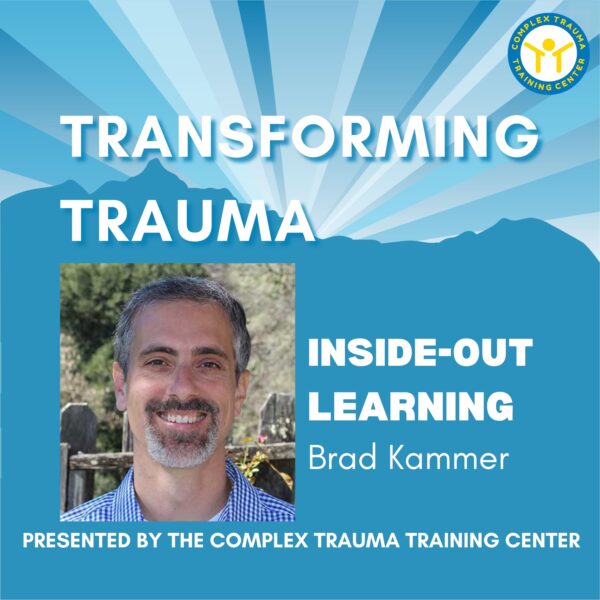
Transforming Trauma Episode 186: Narcissism and Borderline Dynamics from the Inside-Out with Brad Kammer
A podcast brought to you by the Complex Trauma Training Center
|
“In [therapy trainings] there’s a lot of focus on the client. And, of course, our clients are super important, but we’re bypassing something very important when we just focus on our clients.” ~Brad Kammer Today’s clinicians have access to more advanced theories, protocols, and clinical models than at any other time in our profession’s history. Yet, despite all that learning, something essential is often missing: our own humanity. Many therapists enter this field wanting to grow and heal alongside others. But most of the training focuses almost entirely on the client. The result? A profession suffering from high rates of burnout and too few opportunities for therapists to embark on journeys of self-discovery — until now. On this episode of Transforming Trauma, host Emily Ruth is thrilled to welcome back Brad Kammer, Complex Trauma Training Center (CTTC) Director, SPACE Inner Development Program creator, NARM® Senior Trainer, author, and executive producer of this podcast. The pair introduces us to the Inside-Out Learning Series: Transforming Clinical Work from the Inside-Out, a virtual workshop series for professionals committed to deep personal and clinical transformation. Brad also shares his motivation for creating the Inside-Out series and what participants can expect from the workshops’ immersive, experiential and supportive environment. “There’s this famous quote within the psychology world that says, you can’t take someone to a place that you haven’t gotten to know inside yourself,” says Brad. While the passage plays an integral role in Inside-Out’s development, the workshop’s origin story also serves a pragmatic purpose. “Very soon after we started SPACE (CTTC’s inner development program), I realized we needed more time with most of these topics,” Brad recalls. The three stand-alone workshops in the Inside-Out series provide clinicians and other helping professionals with a virtual space to focus on meaningful personal exploration and clinical development. The first workshop — Narcissism from the Inside-Out — reinforced how transformative having space for depth-oriented conversations could be. Instead of focusing on how to identify narcissism in clients, participants were invited to look at the ways narcissistic patterns might emerge in their own inner worlds. Several forms of narcissistic dynamics were covered, including therapeutic narcissism and communal narcissism. Therapeutic narcissism can show up when clinicians unconsciously view their clients’ progress as an extension of themselves — taking pride in successes or blaming themselves when clients struggle. Communal narcissism, on the other hand, can appear in helping professions through a subtle “savior complex” or a need to be seen as morally good and helpful. What made the workshop memorable wasn’t just the content. “Part of the safety is just seeing how common these [patterns] are and that we all share them to some extent,” Brad says, adding that participants showed remarkable vulnerability when sharing their experiences. The atmosphere shifted from overly self-critical to compassionate, inquisitive, and more able to hold complexity without needing to label. Plans are underway to offer a replay of this session. The second workshop — Borderline from the Inside-Out — will take place May 1–2, 2026. Like the narcissism workshop, it won’t focus on diagnosing clients. Instead, it explores the relational dynamics often associated with borderline patterns, especially fears of abandonment, heightened sensitivity in relationships, and difficulty with boundaries. “We’re going to talk about the whole borderline spectrum, and I’m sure most people are going to see themselves somewhere along that spectrum,” says Brad. The series will conclude with Intergenerational and Cultural Trauma from the Inside-Out on November 6–7, 2026. This workshop will explore lineage and ancestral patterns — how family history, cultural experiences, and inherited trauma can live within us even when we don’t consciously know the stories. Stay tuned for a more thorough discussion on this session coming soon! Before logging off, Brad offered a final thought on why Inside-Out is vital to our evolution as clinicians and community members. “Having a space where we could really start to look at some of these things that are more taboo in a safe way, non-judgmental way, it just feels so critical.” Transforming Trauma appreciates Brad for helping us build greater capacity to explore intrapersonal dynamics and hold the complexities of the therapeutic relationship. Reserve your spot in upcoming Inside-Out Learning Series workshops. |
GUEST BIO
Brad Kammer, LMFT, LPCC, is the Training Director and Senior Trainer for the Complex Trauma Training Center. Brad is the Creator of the SPACE Inner Development Program for Therapists and Inside-Out Learning Series. Brad is the Senior Trainer in the NARM® Therapist and NARM® Master Training Programs offered through CTTC. Brad also guides the mentorship programs involving CTTC faculty, training assistants and participants; facilitates the diversity, inclusion and belonging (DIB) group; and is the executive producer of the Transforming Trauma podcast. Brad has a passion for cultivating a professional learning community that provides ongoing training opportunities and mentorship to a diverse group of mental health professionals in their work with complex trauma. Brad is also the co-author of The Practical Guide for Healing Developmental Trauma and The Workbook for Healing Developmental Trauma.
MENTIONS
Subscribe for All Episodes
on your Favorite Service:
We want to connect with you!
Facebook @ComplexTraumaTrainingCenter
Twitter @CTTC_Training
YouTube
Instagram @cttc_training
Learn more about The Complex Trauma Training Center: http://www.complextraumatrainingcenter.com
![Imagery_ Thumbnail [1_1] → RSS _ TTP26011812PM](https://complextraumatrainingcenter.com/wp-content/uploads/2026/03/Imagery_-Thumbnail-1_1-→-RSS-_-TTP26011812PM-scaled-350x350.png "Imagery_ Thumbnail [1_1] → RSS _ TTP26011812PM")
![Imagery_ Thumbnail [1_1] → RSS _ TTP25120410AM](https://complextraumatrainingcenter.com/wp-content/uploads/2026/03/Imagery_-Thumbnail-1_1-→-RSS-_-TTP25120410AM-scaled-350x350.png "Imagery_ Thumbnail [1_1] → RSS _ TTP25120410AM")


![Imagery_ Thumbnail [1_1] → RSS _ TTP25102701PM(1)](https://complextraumatrainingcenter.com/wp-content/uploads/2025/12/Imagery_-Thumbnail-1_1-→-RSS-_-TTP25102701PM1-scaled-350x350.png "Imagery_ Thumbnail [1_1] → RSS _ TTP25102701PM(1)")
![Imagery_ Thumbnail [1_1] → RSS _ TTP25091003AM](https://complextraumatrainingcenter.com/wp-content/uploads/2025/11/Imagery_-Thumbnail-1_1-→-RSS-_-TTP25091003AM-scaled-350x350.png "Imagery_ Thumbnail [1_1] → RSS _ TTP25091003AM")