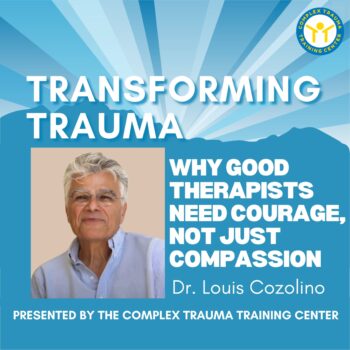
Transforming Trauma Episode 202: Louis Cozolino on Why Good Therapists Need Courage, Not Just Compassion
A podcast brought to you by the Complex Trauma Training Center
|
“You’ve gotta be brave and you’ve gotta be a warrior, as well as figuring out how to be nurturing and caring.” ~Lou Cozolino, Ph.D. Healing happens in environments that support growth and resilience. Yet many clinicians hesitate to challenge a client’s survival strategies for fear of creating tension or conflict in the therapeutic relationship. One psychologist invites trauma-informed practitioners to be brave, to drop their need to be an expert, to build a capacity for tolerating conflict, and to foster a space where clients uncover the answers for themselves. On this episode of Transforming Trauma, host Emily Ruth welcomes Louis Cozolino, Ph.D., an esteemed author and professor known for his extensive work on neuroscience and the human experience. His approach is grounded in the healing power of connection, and emphasizes attunement and relationship while integrating psychodynamic, cognitive-behavioral, family systems, and humanistic perspectives. Lou offers warm, often humorous insights from his 30+ years in the field, including guidance for trauma-informed clinicians on balancing support with healthy confrontation. “A lot of the field over the last decade or two has gone in a direction of safety. The problem with over-indexing on safety is that our clients don’t live in a safe world,” argues Lou. “The old cognitive therapists called it exposure and response prevention, which means you have to face what you’re afraid of.” He uses the language of a “safe enough” space, a technique he learned while training under Carl Rogers, Ph.D., the founder of client-centered psychology. Lou urges therapists to cultivate two distinct but collaborative temperaments for use in this space: a warrior spirit and a nurturing energy. Lou’s professional evolution began with a personal desire to figure out his own mind. A family history of poverty, loss, and trauma also played a role in his development. Growing up, he sensed generational pain, yet struggled to name it. “I was surrounded by the unthought known,” he explains. “No one was speaking about this, but it was palpable.” A quest for answers led him to Strand Bookstore, the legendary seller located in Manhattan’s East Village. “I needed to learn some kind of method to be critical of my own mind,” he explains. He found Buddhism and, later, neuroscience, a nascent field in the early 70s. Lou also discovered an informal community at the Strand. There, he listened to stories from Jewish immigrants who, like him, sought solace in the shop’s aisles. In The Making of a Therapist, Lou observes that most people don’t truly listen; they just take turns delivering monologues. But an attuned therapist can calm the client’s threat-scanner and allow them to turn inward. Those bookstore encounters were an early indication to Lou that presence mattered more than performance. Lou focuses on presence within the therapeutic relationship and places connection at the center of healing. “People primarily need company and a sounding board,” says Lou. “They need ways to process what’s going on in their mind. They don’t need the answer. They need the space to figure out what the answer is for themselves.” Emily and Lou return to the episode’s initial inquiry around connection and interaction. Lou explains how neuroplasticity fits into creating a “safe enough” space for therapy. While the science is valuable, he’s candid about its use, noting that there’s no practical way to “apply” plasticity in session. Lou understands that reality might be unsatisfying, especially for therapists who want to position themselves as neurobiology experts. He urges therapists instead to think of the brain as a social organ, primed for connection. Mentorship can be part of that equation. “If you’re really serious about doing good work, it doesn’t matter how many letters you have after your name,” says Lou. “It’s whether or not you can find a really good senior therapist and cleave to them, and be willing to take the type of feedback you need to hear to learn and to get better.” Transforming Trauma is grateful to Lou for his wisdom and candor. Our community is richer for his research and generosity of spirit. MENTIONED IN THE EPISODE |
GUEST BIO
Louis Cozolino, Ph.D., practices psychotherapy and consulting psychology in Beverly Hills, California. He received his Ph.D. in Clinical Psychology from UCLA and an M.T.S. from Harvard University. He has been a professor at Pepperdine since 1986 and lectures around the world on psychotherapy, neuroscience, trauma, and attachment. With more than 30 years of experience as a psychotherapist and coach, Lou works with adults, adolescents, and families as they face a wide variety of life’s challenges. Lou’s primary method as a therapist is one of connection, attunement, and interaction. Working primarily from a psychodynamic model of treatment, he also uses strategies and techniques from other forms of therapy he has studied, including CBT, family systems, and humanistic/existential.
Subscribe for All Episodes
on your Favorite Service:
We want to connect with you!
Facebook @ComplexTraumaTrainingCenter
Twitter @CTTC_Training
YouTube
Instagram @cttc_training
Learn more about The Complex Trauma Training Center: http://www.complextraumatrainingcenter.com