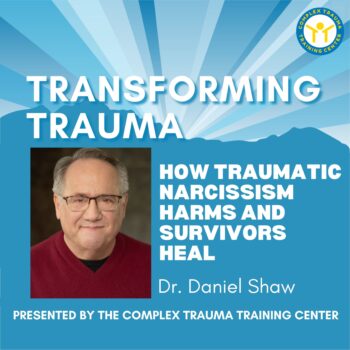
Transforming Trauma Episode 200: How Traumatic Narcissism Harms and How Survivors Heal with Daniel Shaw
A podcast brought to you by the Complex Trauma Training Center
|
“The bottom line for all of the victims of trauma that I work with is that they have become profoundly self-alienated and don’t recognize the harmfulness of their own self-negation.” ~Daniel Shaw Social media platforms are filled with attention-grabbing posts on how to spot, leave, or recover from someone who displays narcissistic characteristics. While those 90-second efforts offer an interesting overview, they rarely provide us with a meaningful foundation for understanding the psychology of a traumatizing narcissist or how their behavior impacts survivors. One psychotherapist has distilled his vast knowledge and personal experience into an insightful and highly accessible 100-page introduction to the concept of Traumatic Narcissism Theory. On this episode of Transforming Trauma, host Emily Ruth welcomes back Daniel Shaw, author of Traumatic Narcissism Theory: A Contemporary Psychoanalytic Introduction, to discuss Traumatic Narcissism Theory (TNT), a framework he created and has refined over roughly thirty years. Through personal story and contributions from many historically influential psychologists, Daniel charts the evolution of narcissism theory and clearly explains the utility of TNT. He also offers clinicians a roadmap for supporting survivors of traumatizing narcissism as they regain their confidence and recover their autonomy. “I hope that I’ll be able to really describe what I believe is most clinically useful about understanding traumatic narcissism,” Daniel begins. He accomplishes all that and more in his third podcast visit, starting with the origin story of his interest in narcissism and the harm it causes. “I began because I had left what I came to see as a religious cult that I’d been very committed to very deeply for 13 years before beginning my graduate degree in social work,” says Daniel. He explored narcissism amongst cult leaders for his thesis, noting that experts at the time viewed these charismatic individuals as sociopaths who wielded mind control over their followers. “But I had just been in a relationship with a cult leader before social work school, and I wasn’t satisfied with that way of thinking.” Daniel discovered that the psychological and sexual abuse, cruelty, dehumanization, domination, and subjugation were features in many other groups and organizations, and isn’t limited to only religious cults. Daniel has come to believe that traumatic narcissism emerges from early childhood experiences of being bullied or profoundly humiliated. The compensatory fantasies of omnipotence then metastasized into delusions. Those delusions, in turn, function like a dam, holding back unresolved feelings of shame, dependency, and impotence. If the dam breaks, an individual risks psychotic decompensation. TNT describes eight main behaviors as typical of traumatic narcissism: love bombing; creating dissociation through coerced disorganized attachment; weaponized suffering; DARVO (Deny, Attack, Reverse Victim and Offender); isolation; provoking jealousy; demanding perfection and purity; and omnipotence. Because the relational violence is more often psychological rather than physical, the behaviors resemble the coercive control studied in domestic violence situations. Daniel’s personal experience under the influence of traumatic narcissism led him to dedicate his career to helping survivors heal from subjugation trauma, which leaves “the victim in a state of complete dysregulation and post-traumatic stress, hypervigilance, and most profoundly, self-alienation, self-blame, and self-punishment,” he observes. TNT begins with stabilization and draws on other modalities like parts work and EMDR. But psychoeducation is also important. “I take pains to educate clients about the impact of trauma on their body, brain, and nervous system. This isn’t done in a manualized, protocol-driven way,” Daniel concedes. “I’ve tried to lay out the concepts in a clear, organized way. But my approach as a mostly psychoanalytically trained person before I ever was trained in the other trauma theories is kind of a talk therapy that introduces information when the client seems ready.” Working with survivors of traumatic narcissism tends to be a slow process. Daniel advises clinicians to take it slow and seek supervision or peer support. It’s not unusual for feelings of frustration and powerlessness to tempt therapists into pushing harder when clients need gentle coaxing. TNT offers an antidote to hopelessness. More than any modality, however, Daniel is struck by the human capacity to heal. “I try to keep my faith in human potential right in front of me as much as I possibly can, especially when it’s hard to do so.” Transforming Trauma is grateful to Daniel for his enduring willingness to trust our community with his personal story and share his incredible professional insights with us. RECOMMENDED EPISODE Traumatic Narcissism: Relational Systems of Subjugation with Daniel Shaw Continuing the Conversation of Traumatic Narcissism and Recovery with Daniel Shaw Healing from Traumatic Love with Dr. Nadine Macaluso What If Narcissism Is a Trauma Adaptation? with Dr. Mark Ettensohn From the Cult of NXIVM to “The Narcissist’s Playbook” with Filmmaker Mark Vicente MENTIONED IN THIS EPISODE |
GUEST BIO
Daniel Shaw, LCSW, is the author of Traumatic Narcissism Theory: A Contemporary Psychoanalytic Introduction, recently published by Routledge. He has been a psychotherapist for the last thirty years based in New York City, while teaching and consulting to other psychotherapists internationally.
Subscribe for All Episodes
on your Favorite Service:
We want to connect with you!
Facebook @ComplexTraumaTrainingCenter
Twitter @CTTC_Training
YouTube
Instagram @cttc_training
Learn more about The Complex Trauma Training Center: http://www.complextraumatrainingcenter.com