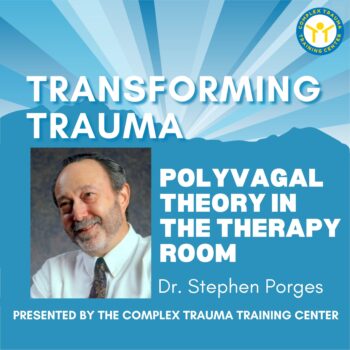
Transforming Trauma Episode 199: Polyvagal Theory in the Therapy Room with Dr. Stephen Porges
A podcast brought to you by the Complex Trauma Training Center
|
“As we start understanding what’s restraining us, we start learning how to unrestrain those issues, and we can become who we really are.” ~Stephen Porges, Ph.D. If psychotherapy is about reconnecting to a genuine expression of self, how do we support connection and embodiment in clients who’ve experienced complex trauma? One noted clinician believes that polyvagal theory offers vital tools for this journey, provided therapists can hold space for vulnerability during the process of co-regulation. On this episode of Transforming Trauma, host Emily Ruth welcomes back Stephen Porges, Ph.D., the renowned behavioral neuroscientist, professor, and author who, in 1994, originated the polyvagal theory framework: a systems-level, pathway-specific model of autonomic regulation. This enlightening conversation explores:
“If the body is locked into a state of survival, you’re not going to be social. You’re not going to be compassionate to others because you’re in pain, you’re in threat,” says Stephen, whose opening remarks highlight his belief that physiology always comes first. “I’m understanding this level of embodiment, what my physiology is telling me, the signaling from my gut, from my heart, and how it gets up and literally distorts how I want to see the world. That’s the real paradox. But once we understand that it’s not our intention, but our body talking to us and it’s driving us in these directions, that we start to respect why and what our body’s doing.” This relational shift lends predictability and even purpose to C-PTSD and PTSD symptoms like hypervigilance, withdrawal, and dissociation rather than pathologizing them. “What we have to understand is that we literally have inherited a physiological or foundational architecture that is fantastic for survival, in a sense signaling us that we’re under life threat,” Stephen explains. “However, once it gets signaled into true life threat or what I’m now calling sentinel trauma, it’s very resistant or reluctant to relinquish its defenses.” So, where does that leave clinicians? Stephen describes therapists as already being fluent in the language of physiological cues. “The therapists, when they’re working with their clients, are seeing that in real time. And when they are, quote, “polyvagal informed,” they’re listening to the voice, looking at the facial expressivity, at muscle tone, at gesture. They’re literally reading the complex physiology of their clients in real time,” he says, before focusing on vocal prosody specifically. “Voice is like heart rate variability,” Stephen observes, citing his own research that shows how a mother’s soothing tone (not just her words) directly lowers her baby’s heart rate. “This is likewise with spouses, friends, or therapists,” Stephen says, pausing to distinguish between empathy (an automatic reaction) and compassion (a “chosen response” that comes from noting our own triggers). In considering the intimate nature of these relationships, he recalls Viktor Frankl’s notion of the space between stimulus and response. Not one to shy away from critique, Dr. Porges addresses recent peer criticism of polyvagal theory, noting how detractors misrepresent his research through bad-faith arguments and obfuscation. Stephen pushes back against academic critiques of his latest paper, Polyvagal Theory: A Journey from Observation to Innervation and Application. “The arguments are what we would call straw man arguments. Every one of the criticisms are not about what the theory says.” Instead, they repeat criticisms that have been answered by the research. “I don’t mind it being criticized, ” he clarifies. “I do mind when it’s presented in an inaccurate way.” One of the episode’s most moving moments stems from Stephen’s recollection of offering trauma survivors hugs after listening to brief accounts of their personal histories. “This accessibility is a gift that gives back manyfold,” he confides, adding, “that is not really understood by most people because it’s not totally an intention. It’s based upon the physiological state I’m in.” Finally, Dr. Porges shares insights from his Safe and Sound Protocol, an acoustic intervention that shows promise in people experiencing PTSD symptoms. Transforming Trauma is grateful to Stephen Porges for once again sharing his life’s work with our community and supporting trauma patients on their journey back to somatic understanding of self. RECOMMENDED EPISODE The Polyvagal Theory & Developmental Trauma with Dr. Stephen Porges MENTIONED IN THIS EPISODE Somatic-Oriented Therapies: Embodiment, Trauma, and Polyvagal Perspectives Polyvagal Theory: A Science of Safety Exploring the Effects of Sonic Augmentation Technology in Music |
GUEST BIO
Stephen W. Porges, Ph.D., is Distinguished University Scientist at Indiana University, where he is the founding director of the Traumatic Stress Research Consortium. He is Professor of Psychiatry at the University of North Carolina and Professor Emeritus at the University of Illinois at Chicago and the University of Maryland. In 1994, Dr. Porges proposed the Polyvagal Theory. The construct links the evolution of the mammalian autonomic nervous system to social behavior and emphasizes the importance of physiological state in expressing behavioral problems and psychiatric disorders. He has published several books and more than 400 peer-reviewed papers.
Subscribe for All Episodes
on your Favorite Service:
We want to connect with you!
Facebook @ComplexTraumaTrainingCenter
Twitter @CTTC_Training
YouTube
Instagram @cttc_training
Learn more about The Complex Trauma Training Center: http://www.complextraumatrainingcenter.com