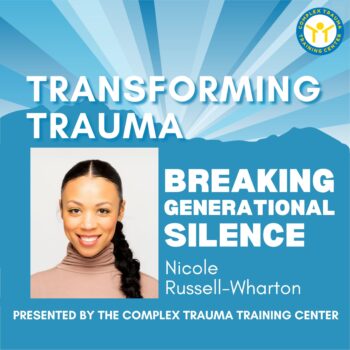
Transforming Trauma Episode 198: Breaking Generational Silence and Healing Inherited Trauma with Nicole Russell-Wharton
A podcast brought to you by the Complex Trauma Training Center
|
“If people don’t understand your needs, they can’t rise to the occasion to fulfill them.” ~Nicole Russell-Wharton Sometimes silence creates space for reflection. But what happens when silence holds unspoken pain, and difficult conversations are increasingly avoided or abandoned altogether? Spoiler alert: suppressing what should be said rarely leads to positive outcomes for our physical or mental wellbeing. So, how do we wade into the turbulent emotional waters of relational silence, confidently embody our role as generational cycle-breakers, and future-proof our lineage? On this episode of Transforming Trauma, host Emily Ruth chats with Nicole Russell-Wharton, founder of the Precious Dreams Foundation and author of “Breaking Generational Silence,” about the liberatory work of disrupting harmful relational patterns. Nicole’s lived experience lends an intensely personal aspect to her professional work. It also provides a blueprint for how we can better advocate for ourselves, our communities, and the children in our care. Together, they discuss how:
“I would love for [the audience] to understand that harmful cycles typically repeat, and it’s not out of a lack of love. Oftentimes, it’s out of a lack of communication skills,” says Nicole. Her opening intention highlights a universal challenge: even families that want to “do better” struggle because they lack the interpersonal safety and language needed to address and repair harm. The fallback position of self-blame or excusing family members for their poor behavior becomes a generational inheritance. Nicole’s healing journey began in 2012 with the founding of Precious Dreams Foundation (PDF) in New York City. PDF started out providing tangible comfort items, such as new pajamas and stuffed animals, to youth impacted by the foster system or experiencing homelessness. “But with every experience, every encounter, every shelter visit, it became very clear to me that there was so much more at stake. We needed to support their mental health,” says Nicole. In 2013, PDF expanded its reach, offering developmental programming and wraparound services. “It’s my full-time work, my biggest passion project to date,” Nicole explains, adding that PDF has served over 30,000 young people since its inception. While the foundation’s origin story accentuates her professional drive, it’s Nicole’s account of a personal medical crisis––a collapsed lung and subsequent diagnosis of thoracic endometriosis––that became the catalyst for deep self-inquiry. “Writing “Breaking Generational Silence” was what I needed at a point in my life where I experienced a near-death experience,” she confides. “In doing the work to understand myself and how I arrived at this moment, I started asking my family more questions about our health history. I discovered two things. One was that a lot of people didn’t have the answers because they never asked questions.” “The other thing that I discovered is it’s very likely my grandmother had endometriosis, and it’s just not something that my mother understood or felt the need to explain to me,” concedes Nicole. The experience reframed “family silence” for her, shifting it from the type of secrets that erupt in a cinematic “reveal” to something more mundane but equally destructive. “When you think about silence, it actually has nothing to do with trauma,” she observes. “A lot of times it’s just suppressed thoughts or repressed emotions.” Nicole offers some practical guidance for disrupting unhealthy generational patterns:
As our conversation draws to a close, Emily Ruth invites Nicole to share her wisdom with anyone ready to break a painful generational cycle. “It’s bigger than you. I think that was my motivation when I was doing this work, and even writing this book. This didn’t initially set out to be a book; this started as me needing to document what I could pass down,” acknowledges Nicole. “Even if we’re scared, even if we’re uncomfortable, It’s necessary to be brave in this work.” Transforming Trauma is grateful to Nicole for giving voice to generational silence. Her work provides a vocabulary for healing and living out loud at a time when so many are told to keep quiet. MENTIONED IN THIS EPISODE |
GUEST BIO
Nicole Russell-Wharton is an award-winning social impact leader, mental health advocate, and co-founder of the Precious Dreams Foundation, a nonprofit serving children and young adults experiencing homelessness and foster care. Through her work, she has helped bring healing-centered programs and resilience-building resources to thousands of young people. Nicole is also the best-selling author of “Breaking Generational Silence,” which explores how uncovering family histories can help interrupt cycles of intergenerational trauma and foster healing.
Subscribe for All Episodes
on your Favorite Service:
We want to connect with you!
Facebook @ComplexTraumaTrainingCenter
Twitter @CTTC_Training
YouTube
Instagram @cttc_training
Learn more about The Complex Trauma Training Center: http://www.complextraumatrainingcenter.com