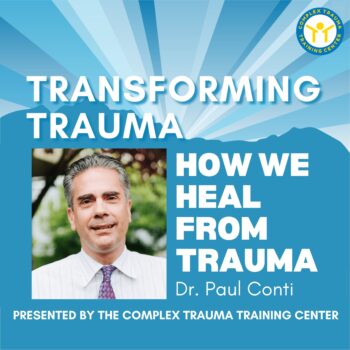
Transforming Trauma Episode 197: How Trauma Changes Us and How We Heal with Dr. Paul Conti, Author of What’s Going Right
A podcast brought to you by the Complex Trauma Training Center
|
“I think to help guide others towards humility, it helps to start with ourselves.” ~Dr. Paul Conti Imagine a chronic, contagious disease has infiltrated your family, yet doesn’t carry any obvious symptoms––no wounds to treat, no cough to suppress, no concerning lab work to address. So, daily life continues, but you can’t shake the feeling that something isn’t quite right: a pattern of emotional instability and mental illness that has proliferated among family members for years, possibly generations. It shows no signs of abating. This is the stealthy and harmful nature of unhealed trauma, an invisible epidemic that one clinician believes is both treatable and preventable. On this episode of Transforming Trauma, host Emily Ruth welcomes Dr. Paul Conti, psychiatrist and author of “Trauma: The Invisible Epidemic,” to explore how unresolved trauma shapes our inner world, interpersonal relationships, and society at large. Paul also shares insights from his latest book, “What’s Going Right: A Powerful Method For Optimizing Your Mental Health,” which offers proven strategies for healing from trauma, including the importance of compassionate curiosity and pursuing happiness through growth and connection “[Mental health] isn’t a black box. It doesn’t have to be scary, and really good things can come of looking at our mental health,” says Paul, who’s sensitive to how difficult those explorations can be for someone who has experienced significant trauma. ”When we’re talking about trauma, sometimes people will see it as a soft topic not rooted in the realness of what happens in people.” Early in his career, however, Paul noticed that many of his clients presented with undeniable biological realities of trauma: diminished coping abilities, higher rates of cardiovascular disease, chronic autoimmune conditions, and accelerated aging. While naming “capital T” trauma is a vital first step in a client’s healing process, some people opt to avoid the difficult intrapersonal work that follows. “Trauma is real inside of us. It changes our brains. When we very much want to solve our problems, we often have a greater difficulty doing so,” says Paul. He asserts that people who shy away from the exploratory phase lack a mechanism for understanding their interior world. “Our mental health has two foundations: the structure of self and the function of self,” Paul says. “In the structure of self is the unconscious mind. Most of what’s going on in our minds is going on in an unconscious way, and that sets the stage. It sets the climate that we’re living in,” he explains. “On top of that, the part of the iceberg sticking out of the water––the smaller part––that’s our conscious mind. It’s what we’re actively aware of.” Foundational repair is possible. Paul’s conceptual tool of choice is compassionate curiosity. When clients begin to reconnect with their agency, they’re more open to recognizing what’s going well for them and exploring what isn’t. Mental health professionals are collaborators in the investigative process; it’s vital that our foundations are intact as well. “We have to have the humility to accept our humanness, and what that does is it leads to an active approach to the world through gratitude,” offers Paul. He encourages therapists to help clients “rewrite” their life narratives, noting that the same factual life story can be told in ways that either reinforce negativity or highlight resilience already present but overlooked. As the conversation draws to a close, Emily invites Paul to expand on his thoughts around the generative drive, a concept he explores in his latest book. Beyond the classical drives of assertion and pleasure-seeking, Paul describes a third, uniquely human drive. The generative drive accounts for our desire to learn for learning’s sake, create beauty, and participate in society. “It keeps those other drives in balance, and it helps keep us healthy in the structure and function of self,” he says, adding, “This is the best of our humanness.” Paul acknowledges how difficult it is for humans, even those free from trauma, to make meaningful behavioral changes. “If I wanna go do good things in the world, but what I’m telling myself inside is that I’m incompetent and nothing’s gonna work, I’m working against myself. But it doesn’t have to be that way. This is not core to any of us. Every one of us has the generative drive in us as our human birthright; none of us has the need or the unavoidability of working against ourselves.” Transforming Trauma thanks Paul for sharing his expertise with our community and reminding us that we are all imbued with the ability to identify what needs to change and pursue it with courage. MENTIONED IN THIS EPISODE Trauma: The Invisible Epidemic What’s Going Right: A Powerful Method For Optimizing Your Mental Health |
GUEST BIO
Paul Conti, MD, is a psychiatrist and the author of “Trauma: The Invisible Epidemic,” a powerful exploration of how unresolved trauma shapes our inner world, relationships, and society. His newest book, “What’s Going Right,” shifts the conversation toward healing, resilience, and our innate capacity for growth and connection.
Known for his compassionate and deeply human approach, Dr. Conti brings together neuroscience, emotional insight, and practical wisdom in a way that feels both accessible and profoundly healing.
Subscribe for All Episodes
on your Favorite Service:
We want to connect with you!
Facebook @ComplexTraumaTrainingCenter
Twitter @CTTC_Training
YouTube
Instagram @cttc_training
Learn more about The Complex Trauma Training Center: http://www.complextraumatrainingcenter.com