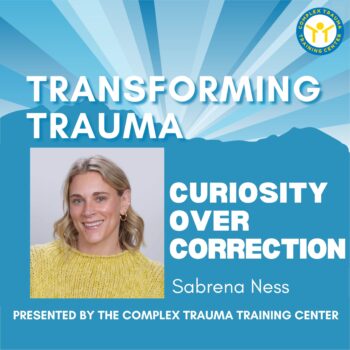
Transforming Trauma Episode 196: Why Neurodivergent Clients Need Curiosity, Not Correction with Sabrena Ness
A podcast brought to you by the Complex Trauma Training Center
|
Comparison is often cited as the thief of joy. For neurodivergent people, comparison is also a source of shame. Imagine receiving constant reminders that your brain doesn’t respond well to, or “fit” with, the dominant societal structure. The messaging can impact self-worth and inform masking behaviors that neurotypical family members, friends, and co-workers fail to understand. One clinician invites care providers to move away from asking “what’s wrong with this client?” in favor of a more holistic line of questioning: “how does their client feel, what adaptations have they made to weather neurotypical norms, and what kind of support do they need now?” “I know that there were a lot of parts of me that took a lot longer to learn things,” says Sabrena, reflecting on her later-in-life ADHD diagnosis. Even with early academic support, she still carried significant shame into adulthood around learning challenges. “I work with a lot of kids that do not get that same support and even adults who never got that support,” she observes. “I internalized pretty early that my brain worked differently, even though I didn’t have the language for that,” says Sabrena, who discovered that ADHD runs in her family. The realization helped her to eventually nurture her abilities rather than “correct” perceived learning deficiencies. It also led Sabrena to clinical research that identified developmental and relational patterns (not just diagnoses) that might be passed down both genetically and environmentally. Sabrena’s personal history and fervent curiosity helped shape her professional therapeutic approach. Early in her career in community mental health, she noticed that standard behavioral methods often backfired with neurodivergent kids—activating them rather than helping, sometimes worsening behaviors. Sabrena grew frustrated with standard cognitive problem-solving models. “CBT, for example, is such a great model for many things. But just thinking about how our thoughts, beliefs, and behaviors are connected and expecting that if I can influence one of those things, all of them will be influenced can be really overwhelming for someone with ADHD or autism,” she explains. NARM helps Sabrena’s neurodivergent clients shift their energy from changing behaviors to understanding what lies beneath the surface. “The core of it felt different,” she recalls. She highlights several key features that make NARM well-suited when working with this population:
Sabrena returns to the topic of shame throughout our conversation, identifying its impact on familial neurodivergent pairings such as romantic partnerships or parent/caregiver and child relationships. Regardless of combination, Sabrena emphasizes that shame isn’t about neurodivergence itself. “It’s not about you needing all these things so that you can be more normal or more neurotypical. It’s so much more about what would support you and the life that you want to live.” Transforming Trauma appreciates Sabrena’s continued support of neurodivergent clients and the communities that they belong to. MENTIONED IN THIS EPISODE |
GUEST BIO
Sabrena Ness is a Clinical Mental Health Counselor (CMHC) in Utah and a Licensed Professional Counselor (LPC) in Colorado. She earned her Master of Science in Clinical Mental Health Counseling from the University of Wyoming. Sabrena is the Clinical Director at LifeStance Health in Utah and has been with LifeStance since 2021. She also serves as a Co-Chair for the Pacific Northwest region of LifeStance’s Diversity, Equity, Inclusion, and Belonging (DEIB) chapter, where she focuses on fostering an inclusive and supportive workplace culture.
As a leader, Sabrena provides strategic guidance to clinical teams, driving initiatives that enhance onboarding, promote clinical excellence, and support staff development. She has successfully collaborated with HR, compliance, and other leadership teams to streamline workflows, improve operational efficiency, and create structured support systems for clinicians. She has a deep passion for supervision, mentoring clinicians in their professional growth, and ensuring high-quality care delivery.
Sabrena specializes in complex developmental trauma and complex PTSD, working with individuals and couples across the lifespan. She is particularly dedicated to supporting LGBTQ+ and neurodivergent populations, creating affirming and effective therapeutic spaces. She is a practitioner in the NeuroAffective Relational Model® (NARM®). She also contributes to the training community as a NARM Training Assistant, reinforcing her commitment to advancing trauma-informed care. Her work emphasizes innovative leadership, continuous improvement, and a deep dedication to mental health advocacy.
Subscribe for All Episodes
on your Favorite Service:
We want to connect with you!
Facebook @ComplexTraumaTrainingCenter
Twitter @CTTC_Training
YouTube
Instagram @cttc_training
Learn more about The Complex Trauma Training Center: http://www.complextraumatrainingcenter.com