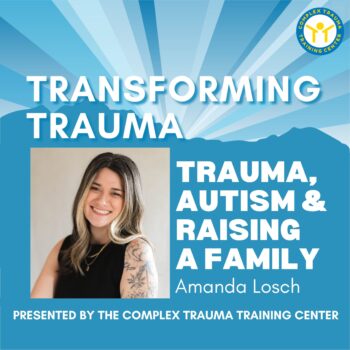
Transforming Trauma Episode 194: Raising Neurodivergent Kids Without Shame with Amanda Losch, NARM® Master Therapist
A podcast brought to you by the Complex Trauma Training Center
|
“ We’re getting better at repairing internally and with our children, and letting go of any expectation of what we thought parenting should look like” ~Amanda Losch They say it takes a village to raise a child. But what do you do when the prevailing support system can’t accommodate the needs of a neurodivergent family? You create your own supportive network. One therapist wasn’t content with simply curating reviews of sensory-friendly playgroups and neighborhood events. Instead, she sought out somatic knowledge and a heart-centered way of being. What she found was a trauma-informed modality and a community of like-minded practitioners. That discovery liberated her from shame and guided her to a more compassionate way of parenting her neurodivergent children. On this episode of Transforming Trauma, host Emily Ruth chats with Amanda Losch, LSCW, a NARM® Master Therapist based outside Chicago who specializes in developmental trauma. Their deeply personal conversation moves beyond clinical theory into the relational, emotional, and somatic realities of parenting while neurodivergent, married to a neurodivergent partner, and raising neurodivergent kids. Amanda credits her early-career training in the NeuroAffective Relational Model®, and ongoing connection to the CTTC-NARM training community, for informing her recovery from trauma, shame, and parental perfectionism while facilitating her growth as a therapist and mother. “This is what I feel like society wants from moms in 2026: heal your own trauma, stay up to date on parenting techniques, have solid relationships, stay regulated all of the time while you’re regulating everybody else, dismantle the patriarchy…” Amanda’s list of internalized demands is long and, unfortunately, familiar to most. “The pressuring of having that figured out on top of all the pressures of being a parent in general has, in my experience and a lot of my clients, led to a lot of shame.” A turning point arrived in the form of burnout so complete that Amanda’s usual coping mechanisms stopped working. In the midst of this exhaustion, she plugged into the capacity to stop shaming herself for the inevitable mistakes of parenthood and the indelible scars of complex trauma. Practice and patience became her twin allies. “Just working on not shaming yourself or moving towards being more human with yourself, theoretically, is the most radical healing piece of it all,” she asserts. NARM played an important role in that revolutionary process. The modality supported Amanda through an exploration of the complex trauma that had shaped her neurodivergent childhood. Expressing deep appreciation for the professional community within CTTC and throughout NARM Trainings, Amanda shares that both of her children were “raised” inside this incredibly supportive community. “What a powerful way to see an example of parents doing it differently, showing these examples of how being a human could look, how being a mom could look, how being a dad could look.” But healing from childhood trauma often bumps up against other personal and institutional challenges. For years, Amanda filtered her differences through a trauma lens exclusively, which limited her growth. “Once I got some of the diagnoses that I did, it allowed me to move from trying to “fix” into accommodating,” she says, clarifying the difference between acceptance and giving up. “This is the reality of how my brain and body work, and I don’t have to effort against that; I can just do things that support how I exist in the world.” Amanda’s family navigates multiple forms of dynamic disability. “I’m glad that we have a family that’s trying to create space for that complexity and has the ability to name and repair some of the systemic failures,” she observes. Modeling accountability for her children means identifying the moments when she gets it wrong and treating them as part of a shared, continual process of learning to be human. As their discussion winds down, Emily invites Amanda to share her perspective on what she wishes more trauma-informed spaces understood about neurodivergent parenting. “It’s a constant sort of parsing,” Amanda confides. She offers several foundational inquiries therapists can use to ground the therapeutic relationship. “Are there parts of your client’s story that could be explained by neurodivergence? And, what do we gain from moving towards an accommodation model versus efforting against?” Transforming Trauma is grateful to Amanda for her candor regarding the realities of neurodivergent parenting. We appreciate her work building a network of accessible, neuro-affirming spaces where every individual can thrive.
MENTIONED IN THIS EPISODE |
GUEST BIO
Amanda Losch, LCSW, is a NARM® Master Therapist in private practice based in the Chicago suburbs, specializing in developmental trauma. Her work is deeply informed by both her clinical training and lived experience as a neurodivergent parent. Currently stepping back from direct practice to care for her neurodivergent family, Amanda is building a local resource network for neurodivergent families and offering education to organizations on safety, accessibility, and inclusion. She brings a thoughtful, grounded perspective to the intersections of neurodivergence, parenting, chronic health, and trauma.
Subscribe for All Episodes
on your Favorite Service:
We want to connect with you!
Facebook @ComplexTraumaTrainingCenter
Twitter @CTTC_Training
YouTube
Instagram @cttc_training
Learn more about The Complex Trauma Training Center: http://www.complextraumatrainingcenter.com