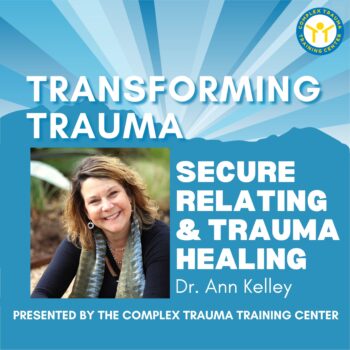
Transforming Trauma Episode 193: Beyond Attachment Styles: Secure Relating & Trauma Healing with Dr. Ann Kelley, Therapist Uncensored
A podcast brought to you by the Complex Trauma Training Center
|
“ I really think the more authentic we are with our own activation, our realness, our own vulnerability, that’s really what therapy’s all about. So, I’ve had to give up some of my own training and become more human instead of more ‘the expert,’ but sometimes that’s hard.” ~Dr. Ann Kelley How can we, as therapists, help people better understand themselves, improve their relationships, and reduce the shame that accompanies emotional struggles that are often rooted in relational trauma? It’s a basic question at the root of our work and on this episode of Transforming Trauma, host Emily Ruth invites psychologist, author, and fellow podcaster Ann Kelley, Ph.D., to address it by demystifying the principles of modern attachment theory. Ann draws on her clinical work, research, and experience as co-creator of the podcast Therapist Uncensored to present a compassionate, up-to-date view of attachment that replaces rigid labels with practical strategies for meaningful relational growth. The conversation also delves into the importance of remaining curious and willing to challenge the limits of our own educational or experiential bias as information evolves. This skill is on full display in Secure Relating: Holding Your Own in an Insecure World, the book Ann co-authored with her “neuronerd” colleague and co-host Sue Marriott, LCSW, CGP. “I would hope people feel less pathologized and less pathologizing of the people that they’re struggling with,” says Ann, framing the episode as an entry point for healing the cycle of shame and blame. Rather than viewing emotional difficulties as evidence that something is wrong, she encourages people to understand their reactions as adaptive protective strategies developed in response to earlier perceived dangers. We often bring these maladaptive strategies into our relationships. “If you’re out there and something’s threatening you, you feel activated,” Ann explains. “You don’t feel secure. That doesn’t mean you’re not relating in a secure way.” If you’ve just experienced a record-scratch moment, welcome to the club. “One of the things we had to unlearn is the Western bias that attachment was just seeped in,” says Ann. Early attachment models categorized people into fixed styles such as anxious, avoidant, or secure. While these categories helped many people recognize themselves, they also could feel limiting and overly simplistic. “We started recognizing that we don’t live in any category. We’re not only preoccupied; we’re not only avoidant,” she observes. “That was so freeing! And, it started to help us more deeply understand what happens in a relationship more organically.” This evolution led to the development of a new concept: secure relating. “We think of it as more of a verb, as an action, as a journey,” Ann explains. “It’s a moment-to-moment state that we could work towards.” Unlike secure attachment, which can sound like a permanent trait or destination, secure relating is an ongoing practice. It’s not something someone either has or lacks. Secure relating is the ability to stay connected to oneself, another person, and the relationship between them, especially during difficult or emotionally activating situations. “We can make active decisions to find ourselves in the body, in our own life, to be able to then relate to our own body and the next person in a more secure way,” says Ann, noting that when individuals can recognize their activation, understand what is happening in their bodies, and communicate authentically, they are practicing secure relating. It’s an essential redirect that shifts the focus from achieving emotional perfection to developing relational capacity. Having an expanded understanding of trauma has informed the development of secure relating. “We’ve grown so much in this idea of how attachment really actually hits our body, how it manifests, how trauma lives on in our body,” says Ann, adding, “We know that trauma is healed by having the experience and feeling less alone with it.” By helping clients recognize protective reactions without shaming them, they can create enough distance to become curious about what they need in that moment. Transforming Trauma thanks Ann for sharing her hopeful yet practical approach to psychological growth. She shares meaningfully on what it means to explore our attachment patterns without judgment or predetermined outcomes. MENTIONED IN THIS EPISODE RECOMMENDED EPISODES The Polyvagal Theory and Developmental Trauma with Dr. Stephen Porges |
GUEST BIO
Dr. Ann Kelley, she/her(s), is a licensed psychologist and the co-founder of Therapist Uncensored, a top-rated podcast and online community. She, along with her wife and co-host Sue Marriott, LCSW,CGP, brings her love and expertise of research and the relational sciences to audiences both nationally and internationally. She translates this extremely relevant and complex information on human psychology and attachment security in a way that is dynamic, understandable and insightful.
Ann resides in Austin, Texas where she specializes in individual and couples therapy. In her former role as a Director of Clinical Treatment for the Texas Youth Commission, she provided workshops, training, supervision, and assisted with agency-wide program development. She has served as an expert witness for courts and national media outlets as a key resource regarding the treatment of early trauma resulting in violence. In her role with Therapist Uncensored, she continues to provide training in interpersonal neurobiology, attachment and relationships. Ann loves her life in the self-proclaimed live music capital known best for “keepin’ it weird” and is an avid runner and margarita enthusiast.
Subscribe for All Episodes
on your Favorite Service:
We want to connect with you!
Facebook @ComplexTraumaTrainingCenter
Twitter @CTTC_Training
YouTube
Instagram @cttc_training
Learn more about The Complex Trauma Training Center: http://www.complextraumatrainingcenter.com