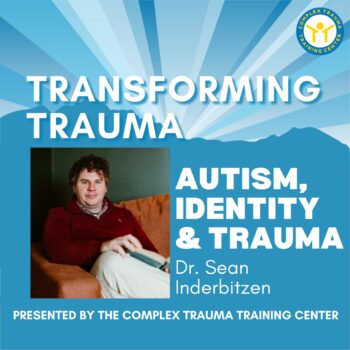
Transforming Trauma Episode 192: Therapy for Neurodivergent Clients with Dr. Sean Inderbitzen, author Neural Exercises for Autism
A podcast brought to you by the Complex Trauma Training Center
|
“ Being realistic about what I can and can’t give the client, I think, is really helpful to good therapy, because I don’t think people just want to be told that everything’s going well. Why do therapy if everything’s going well?” ~Sean Inderbitzen Working with autistic clients can feel incomplete at times. Newer clinicians or those who aren’t neurodivergent may struggle with the dynamics of this unique client/therapist alliance, even as they collaborate on issues related to relationships and empathy. But one autistic psychotherapist and Mayo Clinic researcher urges trauma-informed therapists to stick with this population. He notes that the tools they already use with neurotypical people can also support neurodivergent clients, building capacity for deeper explorations of identity, behavior, and connection in a non-pathologizing environment. On this episode of Transforming Trauma, host Emily Ruth is pleased to welcome Dr. Sean Inderbitzen, DSW, LCSW, a psychotherapist, researcher, and author who has dedicated his practice to advancing autism therapy through innovative, evidence-based approaches. Sean shares insights from his work with individuals on the autism spectrum and previews his new book, Neural Exercises for Autism. He also expands on his assertion that autistic clients can access empathy via somatic integrations like Polyvagal Theory and trauma-informed modalities rather than relying solely on cognitive exercises. The conversation also explores ways clinicians can help neurodivergent clients avoid the “diagnosis-as-identity” trap, focusing instead on what is within their control. And finally, Sean guides our audience through a simple yet effective practice for reclaiming a sense of safety and well-being during periods of dysregulation. Sean asserts that much of autism psychotherapy still operates within frameworks rooted in applied behavior analysis (ABA) and early psychodynamic models from the 1970s, without awareness of richer, more evidence-based tools from innovators such as Dan Siegel, Richard Schwartz, Pat Ogden, and Peter Levine. “There are sort of two schools of thought, and the autism science hasn’t really caught up with the work of identity science,” he explains. To that end, Sean notes that while a diagnosis of neurodivergence can provide peace of mind, it can also become “an excuse to not work at being a better person.” Instead, he views diagnosis as a starting point––helpful in medication decisions and guiding certain intervention––but not the destination. ”What people come looking for in a diagnosis is not the answer to the question of what sort of series of labels will be helpful to my interventions,” he says. “It’s a question of who am I and how do I stop suffering so much?” When diagnosis becomes identity, it can lead to a self-fulfilling prophecy of limitation. Sean bristles at the suggestion that affixing a label to the challenges or injustices of living with autism actually moves the community forward or reduces its suffering. “The things we can control are largely within ourselves, not other people. And, that notion that other people should have to revolve around me,” he reasons, “is the height and epitome of narcissism.” Sean offers a simple yet effective grounding practice that he uses with clients to help them focus on areas where they can make real, functional change. “We can be in the middle of chaos, but if we can bring ourselves back to beauty to create presence, that can be so resourcing to us,” he explains. “And that’s a lot of what this kind of work is about, coming back to this place. Like, how do we allow our bodies to be resources to us instead of enemies in this time when it is so untenable in so many ways?” Transforming Trauma is grateful to Sean for his important work in bringing greater understanding and support to those working with and from the neurodivergent community. MENTIONED IN THIS EPISODE Applied Behavior Analysis (ABA) Internal Family Systems (IFS) RECOMMENDED EPISODES The Polyvagal Theory and Developmental Trauma with Dr. Stephen Porges No Bad Parts and the Self in Healing with Dr. Richard Schwartz, Internal Family Systems Internal Family Systems (IFS) and NARM with Richard Schwartz and Laurence Heller |
GUEST BIO
Dr. Sean Inderbitzen, DSW, LCSW, is an autist psychotherapist and researcher through Mayo Clinic Health System, and the author of Autism in Polyvagal Terms (Norton, 2024). He regularly trains healthcare professionals to be more confident when working with people on the spectrum.
Subscribe for All Episodes
on your Favorite Service:
We want to connect with you!
Facebook @ComplexTraumaTrainingCenter
Twitter @CTTC_Training
YouTube
Instagram @cttc_training
Learn more about The Complex Trauma Training Center: http://www.complextraumatrainingcenter.com