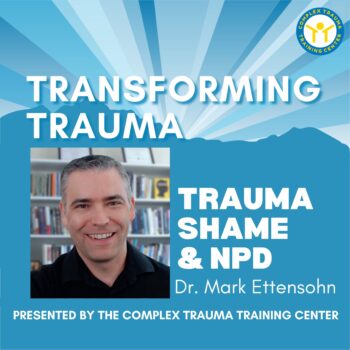
Transforming Trauma Episode 190: What If Narcissism Is a Trauma Adaptation? with Dr. Mark Ettensohn
A podcast brought to you by the Complex Trauma Training Center
|
“I don’t know that there’s anything especially complex about working with NPD. You just have to know what it is that’s showing up and have a sense of how it’s grounded in the individual’s vulnerability.” ~Dr. Mark Ettensohn Narcissism has become a buzz word on social media. It has moved from a psychological understanding to a term that is used for blaming, scapegoating, and other emotionally charged narratives. This polarization has led to casting someone with narcissist traits as a villain who is intentionally cruel, manipulative, and beyond help. While those with narcissistic personality disorder (NPD) can exhibit difficult or even harmful traits, social media has erased the distinction between mental illness and moral defect. One clinician cautions that this “narcisso-sphere” content contributes to the despair of an already vulnerable population and even suicidality among those who identify with the diagnosis. On this episode of Transforming Trauma, host Emilly Ruth welcomes Mark Ettensohn, Psy, D. He offers a corrective to the often sensationalized way NPD is discussed on social media. Mark is the founder of Heal NPD, a clinical and educational platform focused on the understanding and treatment of narcissistic personality disorder. His work explores the developmental and relational roots of narcissism, including trauma, dissociation, and identity. Mark is also the author of Unmasking Narcissism: A Guide to Understanding the Narcissist in Your Life and shares widely followed educational content through his Heal NPD YouTube Channel. Emily and Mark explore the root causes and manifestations of NPD through a compassionate lens, highlighting a need for greater curiosity and more robust assessment tools among clinicians. In doing so, they dispel the myth that NPD is a purely genetic or untreatable diagnosis. “Most of my public-facing work is about humanizing narcissistic pathology, trying to help people understand the complexities involved, particularly concerning pathological narcissism as an adaptation to complex early relational trauma,” Mark begins. NPD shows up in far more varied ways than the “evil narcissist” stereotype suggests. “It’s polymorphic,” explains Mark, meaning it can take many forms. While some presentations align with the grandiose, domineering image popularized online, many are more vulnerable, marked by shame, withdrawal, and hypersensitivity rather than overt arrogance. The distinction matters as it shifts focus from judging behaviors to understanding their underlying psychological processes. This gentle reframe also underscores the commonality of narcissistic traits. “I think this is something that all clinicians see on a regular basis, whether or not they’re in a position to recognize that that’s what it is,” Mark says. Still, he acknowledges the wide gap between clinical reality and viral storytelling. “Some of the biggest channels in psychology are centered around this narrative of the narcissist as this monstrous figure.” In the “narcisso-sphere,” NPD is reduced to generalized behaviors: if someone is controlling, cold, or hurtful, they’re a narcissist. Mark maintains that this “outside-in” approach is insufficient. “That’s not psychology. It doesn’t concern the subjective experience of the individual exhibiting those behaviors.” Without understanding a person’s motivations or internal conflicts, he fears that sound clinical diagnosis devolves into guesswork. Mark traces the roots of NPD to the first few years of life. “Things like chronic attachment disruptions, chronic early adverse childhood experiences––basically, complex relational trauma that’s unfolding during those key windows of identity development––interfere with the mind’s normal developmental trajectory,” he says. The child develops adaptive strategies for maintaining self-esteem and managing overwhelming emotions. NPD, then, isn’t a fixed moral identity or a problem of too much ego. Instead, “it is a treatable issue,” he says. While temperament of the client and clinician plays a role, Mark advocates for sticking with the journey, exploring traumas and relational experiences together and building a foundation for meaningful repair. “Whatever it is that’s showing up, however off-putting it may be, to be able to see it in light of these early adaptations, that fills in the compassionate piece where you can empathize with the individual. That’s the medicine,” he says. “A lot of the work is just tolerating the ups and downs and all-arounds while trying to stay empathically attuned.” Transforming Trauma thanks Mark for sharing his expertise with our community. His empathetic approach to NPD invites curiosity over confrontation and genuine relational support over social media simplification. RECOMMENDED EPISODES Healing Shame and Guilt using NARM® with Dr. Laurence Heller Personality and the Alchemy of Therapeutic Change with Nancy McWilliams, PhD MENTIONED IN THIS EPISODE Unmasking Narcissism: A Guide to Understanding the Narcissist in Your Life Building hope for treatment of narcissistic personality disorder – by Igor Weinberg Psychoanalytic Diagnosis: Understanding Personality Structure in the Clinical Process The Bonds of Love: Psychoanalysis, Feminism, and the Problem of Domination Pathological narcissism and narcissistic personality disorder – Aaron Pincus, et al |
GUEST BIO
Dr. Mark Ettensohn is a clinical psychologist and the founder of Heal NPD, a clinical practice and educational platform dedicated to the understanding and treatment of pathological narcissism and Narcissistic Personality Disorder (NPD). His work focuses on the developmental and relational origins of narcissistic pathology, with particular attention to the role of trauma, dissociation, and identity disturbance. Drawing from psychodynamic, relational, and contemporary integrative approaches, Dr. Ettensohn aims to bring nuance and clinical depth to public conversations about narcissism, a topic that is often misunderstood or oversimplified in popular discourse.
In addition to his clinical practice, Dr. Ettensohn is the author of Unmasking Narcissism: A Guide to Understanding the Narcissist in Your Life. Through his widely followed YouTube channel, Heal NPD, he provides educational content that explores the lived experience of narcissism, the dynamics of narcissistic relationships, and the possibilities for psychological growth and change. His work emphasizes compassion without minimizing harm, and seeks to humanize individuals struggling with narcissistic pathology while helping others understand the complex dynamics involved.
Dr. Ettensohn is also involved in clinical teaching and professional training, and is engaged in ongoing research exploring the developmental pathways associated with narcissistic personality disorder. His work integrates clinical observation, psychological assessment, and emerging research to challenge prevailing myths about narcissism and to promote a more informed and constructive dialogue about personality, trauma, and recovery.
Subscribe for All Episodes
on your Favorite Service:
We want to connect with you!
Facebook @ComplexTraumaTrainingCenter
Twitter @CTTC_Training
YouTube
Instagram @cttc_training
Learn more about The Complex Trauma Training Center: http://www.complextraumatrainingcenter.com