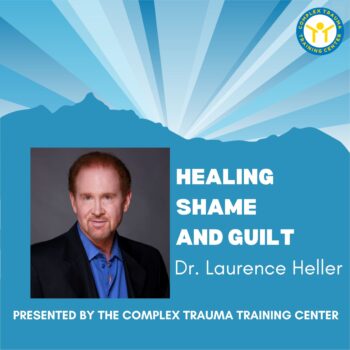
Transforming Trauma Episode 189: Healing Shame and Guilt using NARM® with Dr. Laurence Heller
A podcast brought to you by the Complex Trauma Training Center
|
“Most of the shame that we feel has nothing to do with who we are.”~Dr. Laurence Heller How do you define shame? Would you describe shame as an unproductive emotion or self-reproach? Or, would you dive headlong into examples, chronicling instances when you felt deserving of blame? Either answer is an invitation to probe deeper, to assess how this complex adaptive strategy has limited your ability to relate to yourself, your community, and the world. On this episode of Transforming Trauma, host Emily Ruth is honored to welcome back to the Transforming Trauma podcast Dr. Laurence Heller, creator of the NeuroAffective Relational Model® (NARM®) and author of the new book Healing Shame and Guilt: The Developmental Roots of Chronic Shame and Guilt and How the NeuroAffective Relational Model (NARM) Can Help You Heal and Reconnect. The pair explores the dynamics of shame and its relationship to unresolved trauma. They assess its protective nature, discuss the disidentification process, and explain how NARM® reshapes the fixed, overwhelming qualities of shame into something that can be observed and worked with over time. “I don’t believe that shame is an emotion. I do believe it’s a process. It’s something that we developed,” explains Dr. Heller. “It had survival value for us, no matter how it developed. But, some aspects of shame are things that we’ve directly taken in messages about ourselves, that we’ve taken in from significant others, parents, caregivers, even our culture.” When children experience disconnection, misunderstanding, or harm—especially in relationships with caregivers—they often internalize the belief that ‘something is wrong with me.’ This self-blame, says Dr. Heller, helps preserve attachment to caregivers, which is essential for survival. In this sense, shame is identified as a protective function. However, what was once protective can become limiting in adulthood, leading people to restrict their lives, avoid vulnerability, and hold back from authentic expression. Therein lies the “hidden dimension” of shame, a narrowing that affects not just what people feel, but what they don’t do because of it. The more developmental trauma a person has experienced, the more deeply shame-based identities tend to take root. “[The book] puts more focus on how to work with shame and the protective function that shame served,” says Dr. Heller, adding, “As clinicians, understanding that makes such a huge difference in how effective we can be in our interventions with clients who are struggling with their own shame.” Rather than trying to “fix” shame through more superficial suggestions and skills—the likes of which are often found on social media—NARM® takes a relational, depthful, and process-oriented approach. Clients are encouraged to look beyond their cognitions and behaviors into deeper psychobiological patterns that are emerging in the present moment—especially the various ways self-shaming shows up in thoughts (top-down) and bodily awareness (bottom-up). The body/bottom-up integration is a crucial element of NARM®, “because that’s one of the deepest levels of knowing that we have,” says Dr. Heller. “Paying attention to that bottom-up work is essential, otherwise we’re just kind of lost in concepts and ideas.” Dr. Heller invites clinicians to get curious about their own shame also from a top-down/bottom-up perspective. “I think what a lot of clinicians maybe don’t understand about shame is that it’s not an absolute principle. Generally, the more severe and significant the developmental trauma a person has experienced, the deeper their shame, the deeper their self-hatred.” Any conversation about shame wouldn’t be complete without addressing broader influences, including culture and intergenerational messaging. Shame is often passed down through families and reinforced by society—particularly around sensitive areas like sexuality. These influences can create deep internal conflicts that persist into adulthood. Ultimately, the process of working through shame involves embracing vulnerability. “[In NARM,] we don’t try to avoid those things that might spur more self-shaming,” Dr. Heller offers. “We just make that a part of the process, too.” While this can feel uncomfortable initially, it can lead to powerful shifts for clients—including greater vitality, connection, and freedom. Transforming Trauma is grateful to Dr. Heller for helping us get a deeper understanding of shame and guilt as universal human experiences, the ways they harm us, and how we can heal from them. |
GUEST BIO
Laurence Heller, Ph.D., is the creator of the NeuroAffective Relational Model® (NARM®), an international trainer, and co-author of Healing Developmental Trauma: How Early Trauma Affects Self-Regulation, Self-Image and the Capacity for Relationship and Crash Course: A Self-Healing Guide to Auto Accident Trauma and Recovery. Dr. Heller co-authored The Practical Guide for Healing Developmental Trauma: Using the NeuroAffective Relational Model to Address Adverse Childhood Experiences and Resolve Complex Trauma, which presents one of the first comprehensive therapeutic models for addressing complex post-traumatic stress disorder (C-PTSD), introducing an integrated mind-body approach for treating attachment, relational, cultural, and intergenerational trauma. Dr. Heller’s most recent book, Healing Shame and Guilt: The Developmental Roots of Chronic Shame and Guilt and How the NeuroAffective Relational Model (NARM) Can Help You Heal and Reconnect, is co-authored with Stephan Konrad Niederwieser released in May, 2026.
Dr. Heller is the Director of the NARM® Training Institute and teaches regularly in the US and Europe.
Subscribe for All Episodes
on your Favorite Service:
We want to connect with you!
Facebook @ComplexTraumaTrainingCenter
Twitter @CTTC_Training
YouTube
Instagram @cttc_training
Learn more about The Complex Trauma Training Center: http://www.complextraumatrainingcenter.com