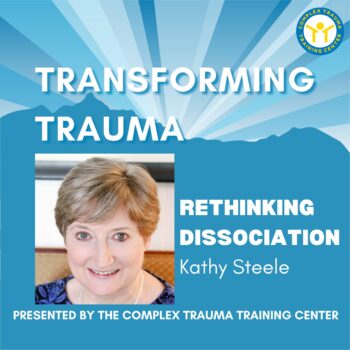
Transforming Trauma Episode 187: Dissociation Isn’t What You Think: DID, Structural Dissociation & Therapist Confidence with Kathy Steele
A podcast brought to you by the Complex Trauma Training Center
|
“In trauma survivors, there is always this conflict between knowing and not knowing. And, there’s always a little bit of knowing and not knowing at the same time.”~Kathy Steele Have you ever slipped so far into a daydream that you felt detached from reality, your emotions, or your sense of self? Brief moments of dissociation are understandable and can even preserve our mental well-being in times of intense stress. Persistent dissociation, however, is something else entirely. It’s a maladaptation that often hints at layers of complex trauma––and that can intimidate therapists. One clinician invites us to reconnect with the deeply human experience of “spacing out” and remain curious about the mind’s capacity to protect and survive before referring our clients to another practitioner. On this episode of Transforming Trauma, host Emily Ruth invites trauma and dissociation specialist Kathy Steele, MN, CS, to share professional observations from her 40+ years of experience working with clients, supervising therapists, and developing treatment guidelines for dissociative disorders and complex PTSD. In addition to a thorough examination of dissociative identity disorder (DID), the pair explores the concept of structural dissociation, a theory Kathy helped develop, and the adaptive strategies that accompany both. Kathy also offers sage advice to clinicians, especially those in the early stages of their careers, who feel inadequately prepared to care for clients with DID. For those who may not be familiar with her work, Kathy is a past president and fellow of the International Society for the Study of Trauma and Dissociation and has served on the board of the International Society for Traumatic Stress Studies. She’s the author and co-author of award-winning books, including The Haunted Self and Coping with Trauma-Related Dissociation. She continues to shape the field through her teaching, writing, and supervisory work. “Dissociation is not weird. It’s not fantastical. It’s understandable, and any good therapist can work with somebody who is highly dissociative,” explains Kathy, who’s spent her career challenging that misconception. She urges clinicians to expand their capacity by collaborating with supervisory cohorts rather than immediately referring DID clients elsewhere. “I want people to come away with a little more confidence and clarity,” she says of our conversation. “What we get in DID is a dissociation between various senses of self,” Kathy continues. “Self is not a thing that I can pull out and say, here’s Kathy’s self.” Instead, she views self as a mental representation that develops over time, starting in childhood, especially through secure attachments. When development is disrupted—through trauma, neglect, or abuse—different fragments of experience fail to integrate. In DID, these become more distinct, leading to a fractured sense of identity where parts of a person’s experience feel like they don’t belong to them. Kathy describes DID not as multiple personalities in a sensationalized sense, but as a lack of ownership over incidents or vast swaths of time. “[One] might say, I know that must have happened to me, but it doesn’t feel like it.” Therapy, then, is about helping integrate these fragments into a more cohesive-enough sense of self to function and feel grounded. Structural dissociation, a concept that Kathy helped develop, emphasizes trauma as an “insoluble dilemma” in childhood. A child must attach to a caregiver for survival, but if that caregiver is also the source of danger, the child must connect with and defend against the same person. “A part of the client tries to go on with daily life and maybe focus on relationships,” observes Kathy. “And another part of the client is kind of stuck in the trauma.” While Kathy acknowledges that it’s unsettling the first time a therapist encounters DID, she reaffirms that clinicians have the basic skills to begin treating those clients. “These are normal defenses that anybody would develop in the face of severe trauma. They just take on a life of their own,” she says. “It’s just like anything else. You need some practice in working with it.” Transforming Trauma is grateful to Kathy for destigmatizing DID and empowering our community to approach dissociative clients with curiosity and understanding. |
GUEST BIO
Kathy Steele, MN, CS, has been in private practice in Atlanta, Georgia, for over 40 years. Kathy is a Fellow and a past President of the International Society for the Study of Trauma and Dissociation (ISSTD) and is the recipient of a number of awards for her clinical and published works, including the 2010 Lifetime Achievement Award from ISSTD and an Emory University Distinguished Alumni Award. She has authored numerous publications in the field of trauma and dissociation, including three books, and frequently lectures internationally on topics related to trauma, dissociation, attachment, and therapeutic resistance and impasses. She retired from clinical practice in December 2025 but will continue teaching.
MENTIONS
International Society for Traumatic Stress Studies
Dissociation: An insufficiently recognized major feature of complex posttraumatic stress disorder
Coping with Trauma-Related Dissociation: Skills Training for Patients and Therapists
Finding Solid Ground: Overcoming Obstacles in Trauma Treatment
The Haunted Self: Structural Dissociation and the Treatment of Chronic Traumatization
Miss America by Day: Lessons Learned from Ultimate Betrayals and Unconditional Love
Nanette Auerhahn, Ph.D.
International Society for the Study of Trauma and Dissociation.
Subscribe for All Episodes
on your Favorite Service:
We want to connect with you!
Facebook @ComplexTraumaTrainingCenter
Twitter @CTTC_Training
YouTube
Instagram @cttc_training
Learn more about The Complex Trauma Training Center: http://www.complextraumatrainingcenter.com