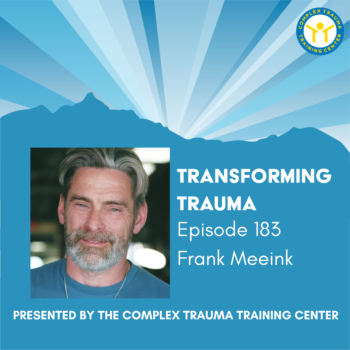
Transforming Trauma Episode 183: From White Supremacy to Radical Human Connection with Frank Meeink
A podcast brought to you by the Complex Trauma Training Center
|
Most of us know what it feels like to sit with a person who is suffering and sense that nothing we say will land, that the distance between our words and their pain is simply too wide. And then someone walks in, sits down, and says two words that change everything: me too. Not advice. Not a program. Just presence, forged in the fire of having been there. That simple offering, one person’s honest experience meeting another’s desperation, is the thread that runs through every minute of this conversation. On this episode of Transforming Trauma, Emily Ruth welcomes Frank Meeink, a former white supremacist turned peer support specialist and recovery advocate, for a searingly honest conversation about what it actually takes to stop burning your life to the ground and start being of use to others. The pair explores the difference between performative vulnerability and purposeful sharing, why humility might be the most misunderstood word in recovery, and how a life of service can quietly rebuild the self-esteem that trauma and addiction hollowed out. Frank’s story spans decades and defies any tidy arc. Raised by parents struggling with their own addictions in rough Philadelphia neighborhoods, he found the first people who ever asked him about his life at the age of 14, inside a neo-Nazi group. “If I came home with a black eye or a trophy, neither of my parents would say, how’d you get that, son?” he recalls. The white supremacists were curious. They listened. They gave a scared boy something that felt like belonging, even though it was built on hatred. Frank went on to live in neo-Nazi compounds across the country during what should have been his high school years, before eventually leaving the movement and devoting himself to civil rights work and deradicalization. But sobriety remained elusive. He cycled through rehabs, built extraordinary careers in hockey coaching, radio, and international speaking, and burned each one down. “I would get sober for a little bit and I would build up a big, beautiful life and do great things,” he says. “And then I burned it down in front of everybody.” The turning point, Frank explains, was not willpower. “I don’t even know who Will is. My name is Frank.” It was a moment of total collapse in a car, screaming out to God to end his life, and hearing something back. He describes it as the gift of desperation, and emphasizes that this was not a moment of self-generated strength but one of surrender. He called an older man in Los Angeles, a mentor from the rooms of recovery, and moved across the country to begin what has now become six years of sobriety. What emerged from that surrender was a daily practice Frank calls STAY: Stop Thinking About Yourself. He describes the relentless mental loops of resentment and personalization that fueled his addiction, the imagined confrontations with people who wronged him, the obsessive narratives about a friend who didn’t text back. “John doesn’t think about me the way I think about me, and he didn’t do it personally,” he says. STAY became his interruption, his way of catching the self-centered spiral before it pulled him under. Paired with daily God walks, morning hours of prayer and listening, these practices form the infrastructure of a recovery that is less about abstinence and more about reorientation, a turning outward after decades of turning inward. Frank now works for Share, the Self-Help and Recovery Exchange in Los Angeles, as a peer support specialist. His most distinctive role is what he calls undercover recovery. Contracted through Apple, he works at a store near Skid Row, posing as a customer. When unhoused individuals or people who appear to be struggling come in, he approaches them casually, strikes up a conversation, and carries a backpack full of resources: meeting locations, housing information, legal aid contacts. He does not lead with advice or programs. He leads with presence. “They might not even be receptive to that right now,” he says. “Just let me listen. Acknowledge and accept their presence. Make space for them. That’s what people just need today.” One of the most striking threads in this conversation is Frank’s evolving relationship with his own story. For years, he describes himself as a self-deprecating narcissist, someone who would share his most harrowing drug adventures at dinner parties with people who had no context for them, then feel hurt when those same people judged him. The shift came when he began to understand humility, not as a performance but as a practice. The conversation closes with what Frank calls the broken vessel metaphor. “God uses the broken vessels to help others,” he says. “The broken vessels, when put back together, our light shines different. It doesn’t shine like everyone else’s, because it’s been broken and now reassembled.” He is careful not to romanticize the breaking. The pain was real. The harm was real. But the reassembled vessel catches the eye of someone who needs to see that particular kind of light, a light that only shines that way because of what it has been through. “There’s nobody that can’t be put back together,” he says. “People are not thrown away.” Transforming Trauma is deeply grateful to Frank for his honesty, his humor, and his willingness to model the very practices he describes. His insistence that recovery is not willpower but surrender, not performance but service, not isolation but the quiet power of me too, offers something genuinely useful to anyone who walks alongside people in pain. |
GUEST BIO
Frank Meeink is a renowned speaker, author, and activist, widely recognized for his efforts in combating racial hatred and extremism. Meeink is the author of “Autobiography of a Recovering Skinhead,” and his story has been featured in numerous documentaries and news outlets, including Steven Spielberg’s “Why We Hate,” and on major networks such as CNN, MSNBC, Fox News, MTV, VH1, BET, and NPR, highlighting his expertise and experiences in the field of hate group dynamics and reform. In addition to his literary contributions, Meeink has been an active voice in community outreach and education. He has spoken widely about his experiences, and co-founded “Life After Hate,” an organization dedicated to helping individuals leave extremist groups. His journey took a profound turn when he discovered his Jewish heritage, leading him to start practicing Judaism and reinforcing his commitment to promote love over hate. Recognized for his impactful work, Meeink received the Civil Rights Hero of the Year award from the Anti-Defamation League in 2016. His testimony before the United States Congress on the infiltration of white supremacy in police departments further underscores his commitment to societal change and his role as a leading figure in the fight against racism and extremism.
Subscribe for All Episodes
on your Favorite Service:
We want to connect with you!
Facebook @ComplexTraumaTrainingCenter
Twitter @CTTC_Training
YouTube
Instagram @cttc_training
Learn more about The Complex Trauma Training Center: http://www.complextraumatrainingcenter.com