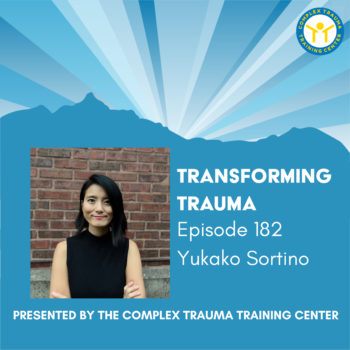
Transforming Trauma Episode 182: Reimagining Trauma Healing for Refugees with Yukako Sortino, Manager of Refugee Behavioral Wellness Program
A podcast brought to you by the Complex Trauma Training Center
|
The reality of trauma in refugee and immigrant communities is anything but simple. In this moving conversation, Yukako Sortino invites us to consider what healing can truly look like when “trauma is not just clinical diagnosis or struggle, it’s relational, systemic,” and woven through stories of both oppression and resilience. The urgency of this work is palpable: refugees and immigrants don’t just carry the wounds of the past, but are navigating the pressures of resettlement, systemic racism, and continual displacement in real time. Listeners are called not just to empathy but to “a deeper, deeper reverence for the complexity of healing in these communities.” On this episode of Transforming Trauma, host Emily Ruth sits down with Yukako Sortino, trauma-informed psychotherapist and Manager of the Refugee Behavioral Wellness Program in Chicago. Together they explore the nuanced realities of trauma shaped by a “triple trauma paradigm”—pre-migration, migration, and post-migration stress—and why healing must be seen as both a personal and collective act. Yukako details how her integration of the NeuroAffective Relational Model® (NARM®) becomes less about symptom reduction and more about relational presence: “Curiosity instead of interpretation, co-regulation before self-regulation,” and honoring survival strategies not as pathology, but as wisdom that helped people endure. Yukako Sortino, LCSW, leads the Refugee Behavioral Wellness Program at Heartland Alliance Health, supporting refugees, asylum seekers, and undocumented immigrants through culturally responsive, trauma-informed care. Drawing from her lived experience across multiple countries and decades in community development, she integrates modalities like NARM, CBT, ACT, and trauma-sensitive yoga to meet people where they are. In addition to her leadership and clinical practice, she mentors graduate students, serves as a consultant globally, and remains deeply rooted as a published writer and advocate prioritizing holistic, non-pathologizing support for communities in transition. Throughout the conversation, Yukako returns to the heart of trauma care: honoring the full dignity and humanity of each person. She speaks candidly about the challenges—balancing Western clinical frameworks with ancestral healing, contending with funding limitations and staff burnout, and witnessing the effects of ongoing injustice. “Healing is deeply relational, cultural, and it’s a political act. It’s about returning to ourselves.” She describes moments where micro-interventions—“Hey, I’m here. We can slow down. You don’t have to explain your pain to me”—can be radical pivots toward safety and liberation. A case example underscores how reclaiming agency, voice, and the right to feel is both a somatic and political process, one often ignited in the presence of simple attunement or cultural rituals, far beyond the therapy room. If there is a central takeaway, it is the imperative for providers and communities to “interrupt harm,” create spaces where healing can unfold at its own pace, and recognize that “rest, sustainability, and community care—not luxuries, they’re the ethical responsibilities.” Yukako reminds us that, without resisting the conditions that produce burnout and disconnection, cycles of trauma are unwittingly replicated. Community care, collective practice, and the integration of culturally grounded approaches become the bedrock not just of individual recovery, but of collective liberation. Listeners will leave this episode with a renewed sense of reverence for trauma healing as an act of resistance, shaped by collective care and the courage to slow down, both with others and within ourselves. The conversation stands as both a compassionate invitation and a call to action for authentic, culturally attuned presence in the work of transforming trauma.
|
GUEST BIO
I am a quite passionate and dedicated psychotherapist specializing in trauma-informed healing support for undocumented individuals, asylum seekers, parolees, and refugee populations. As the Program Manager for the Refugee Behavioral Wellness Program at Heartland Alliance Health, I oversee our behavioral program and also provide individual, couples, family, and group therapy to refugees, asylees, Afghan and Ukrainian humanitarian parolees, victims of trafficking, Special Immigrant Visa holders, and Cuban and Haitian entrants. In addition to my role at Heartland, I run a private practice, offering psychotherapy mostly to immigrants including uninsured individuals, and serve as a field consultant at the University of Chicago and other community initiatives. Before transitioning into psychotherapy, I worked extensively as a case manager, program administrator and advocate for undocumented immigrants, refugees, and asylum seekers in both Australia and Chicago.
Having been an immigrant myself for more than half of my life, I deeply understand the challenges of navigating racial discrimination, systematic and structural oppressions, socio-cultural and linguistic barriers, and cultural stigma around mental health. I have personally grappled with complex developmental trauma and addiction, further complicated by cultural biases and shame-based identity structures common in many Asian communities. My own journey of healing has shaped my passion for making mental health support more accessible to refugees and immigrants, ensuring that healing spaces honor cultural and spiritual identities while also providing individuals with the tools to reclaim their personal agency.
MENTIONS
Subscribe for All Episodes
on your Favorite Service:
We want to connect with you!
Facebook @ComplexTraumaTrainingCenter
Twitter @CTTC_Training
YouTube
Instagram @cttc_training
Learn more about The Complex Trauma Training Center: http://www.complextraumatrainingcenter.com