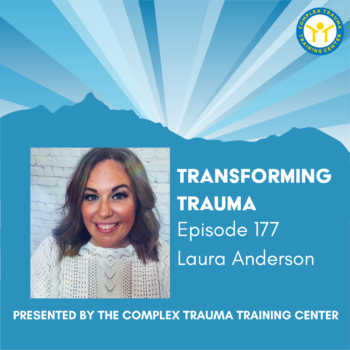
Transforming Trauma Episode 177: Healing and Recovery from Religious Trauma with Laura Anderson
A podcast brought to you by the Complex Trauma Training Center
|
What does it mean to recognize religious trauma as a form of complex trauma? This episode of Transforming Trauma opens up a fresh conversation around a subject that’s often minimized or misunderstood, challenging listeners to consider the embodied impact of adverse experiences within high-control religious systems. Dr. Laura Anderson joins host Emily Ruth to explore how complex and unique these wounds can be, and why the path toward healing must honor each individual’s experience. On this episode, Emily Ruth invites Dr. Anderson to unpack not only her professional focus on religious trauma but also how her personal journey as a “full-time [religious] camp kid” shaped her work. Dr. Anderson speaks to the subjective and individualized nature of trauma, noting that experiences are never one-size-fits-all—even among siblings raised in identical environments. She also reflects on founding the Religious Trauma Institute and crafting a definition that “leaves all this spaciousness for people to have different experiences,” fostering inclusivity and validation for those who may not resonate with traditional abuse or trauma frameworks. Dr. Laura Anderson brings a rare blend of clinical expertise and lived experience to her work. As a therapist, author, and co-founder of the Religious Trauma Institute, she specializes in helping clients navigate the lingering effects of religious and spiritual harm. Laura’s professional approach is deeply informed by her own upbringing within evangelical Christianity and her eventual journey through and beyond its boundaries. In addition to her clinical practice, she leads the Center for Trauma Resolution and Recovery and has written the book *When Religion Hurts You*. Her advocacy centers on giving clients language and agency in their healing, always prioritizing choice and spaciousness over prescriptive solutions. In this conversation, key themes include the impact of high-control religious environments as complex trauma, the process of reclaiming autonomy and agency, and the necessity of giving clients language that matches their experience. As Laura points out, her approach is not to “vilify religion or to try to get people to become atheists as away from healing from a high control religion, but rather to say we need to look at the person’s body, the person’s physiology and start to understand, um, how trauma is living inside of them.” Dr. Anderson introduces the term “adverse religious experiences” as a way to make room for nuance, observing, “Just because something was adverse for me doesn’t necessarily mean that it was adverse for you.” Both Emily Ruth and Laura highlight the importance of walking clients through gradual, embodied healing, focusing on integration rather than chasing an endpoint. They also reinforce that “healing is a living ongoing process,” not a finite state, and celebrate those moments where clients realize they have more choices and self-compassion than before. Dr. Anderson’s candid reflections and open-hearted wisdom illuminate a path for anyone seeking to navigate or support healing from religious trauma. Transforming Trauma extends deep gratitude to Laura for her clarity, warmth, and dedication to creating space for every client’s voice. Her commitment to trauma-informed, client-centered care offers hope and guidance to clinicians, survivors, and those still searching for language to name their experiences.
|
GUEST BIO
Dr. Laura Anderson (PhD, Saybrook University; LMFT) is a therapist, trauma resolution and recovery coach, writer, educator, and creator who specializes in complex trauma with a focus on domestic violence, sexualized violence and religious trauma. Laura has a private practice in Nashville, TN and is the founder and director of the Center for Trauma Resolution and Recovery, an online coaching company where she and the other practitioners work with clients who have experienced high demand/high control religions, adverse religious experiences, cults, and religious trauma.
In 2019, Laura co-founded the Religious Trauma Institute with the goal of providing trauma-informed resources, consultation, and training to clinicians and other helping professionals who work with religious trauma survivors. Laura’s first book, “When Religion Hurts You: Healing From Religious Trauma and the Impact of High Control Religion”, was released by Brazos press in October 2023. She lives with her dog, Phoebe, in Nashville, Tennessee.
Subscribe for All Episodes
on your Favorite Service:
We want to connect with you!
Facebook @ComplexTraumaTrainingCenter
Twitter @CTTC_Training
YouTube
Instagram @cttc_training
Learn more about The Complex Trauma Training Center: http://www.complextraumatrainingcenter.com